Text-conditioned full-body human–object interaction (HOI) generation requires synthesizing human motion and object trajectories that match the input text while remaining precisely coordinated over time. Most methods represent the human and object as separate trajectories and predict the global human–object couplings. Learning this complex, dynamically changing relationship implicitly, however, often yields object drift, missed contact, and penetration.
We introduce PAMI, a Part-Anchored Motion framework for Interaction generation. Inspired by the classic Hough Transform, our key idea is to localize object motion by letting body-part anchors vote for it: we express object motion relative to multiple body-part anchors and use PamiVAE to learn an interaction latent space, decoding frame-wise weights that aggregate these part-specific votes. Building on this representation, PAMI generates interactions in a coarse-to-fine hierarchy. PamiGen first generates a coarse human–object interaction from text in this structured latent space, and PamiRefiner then recursively resolves fine-grained contact geometry using a hybrid surface-sensing representation, combining long-range probes that capture overall body-part influence with short-range sensors that resolve detailed contacts near the object surface.
Experiments on InterAct show that PAMI generates more faithful interactions and more accurate human-relative object motion than previous methods, achieving 14.5% higher contact recall than the previous state of the art. Extensive ablations validate the contributions of both the part-anchored voting representation and hybrid surface-sensing refinement.
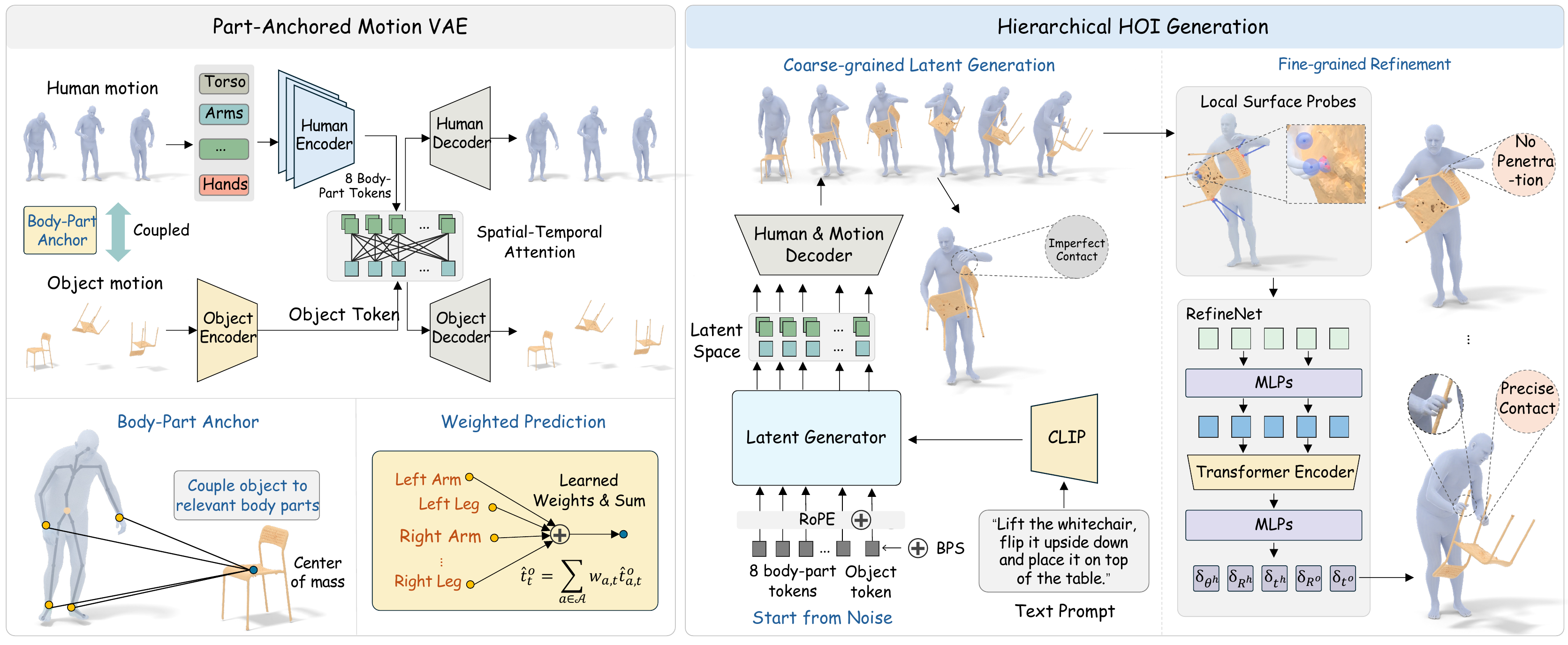
Overview of PAMI. PamiVAE encodes the human motion into body-part tokens and the object motion relative to body-part anchors (root, wrists, ankles) plus a free anchor; per-frame learned routing weights aggregate the anchor-relative predictions into the object trajectory, coupling object motion to the body parts that carry it. PamiGen generates the coarse interaction latent from the text prompt (CLIP), and PamiRefiner recursively refines the decoded motion using long-range body-part probes and short-range surface sensors around the hands, predicting updates to the human pose and the object pose until contacts are precise and penetration-free.
All methods receive the same text prompt and object mesh. We compare against LIGHT and InterAct. Inside an annotated failure interval the body is tinted purple for floating / lost contact and pink for penetration.
PAMI (Ours)
LIGHT
The tripod moves independently of the body.
InterAct
The tripod is never placed back down.
PAMI (Ours)
LIGHT
No grasp is established before the object moves.
InterAct
The chair rotates in the air without a matching body motion.
PAMI (Ours)
LIGHT
The object floats away from the hands.
InterAct
The object floats away from the hands.
PAMI (Ours)
LIGHT
The cylinder spins above the hand instead of being held.
InterAct
The cylinder is not in contact with either hand.
PAMI (Ours)
LIGHT
No clear grasp or forward passing motion is produced.
InterAct
The object stays detached from both hands for most of the clip.
PAMI (Ours)
LIGHT
The object floats away from the hands.
InterAct
The object floats away from the hands.
PAMI (Ours)
LIGHT
The hand never performs a grasping motion.
InterAct
The chair is not set back down at the end.
PAMI (Ours)
LIGHT
The object floats away from the hands.
InterAct
The object floats away from the hands.
We examine the components of our approach in four parts: the effect of PamiRefiner on physical interaction quality, how anchor routing behaves over time, and what is lost without body-part anchors (Table 2, row c) or without an absolute root (Table 2, row e).
We show the same generated sequence before and after PamiRefiner.
w/ PamiRefiner (Ours)
w/o PamiRefiner
w/ PamiRefiner (Ours)
w/o PamiRefiner
w/ PamiRefiner (Ours)
w/o PamiRefiner
w/ PamiRefiner (Ours)
w/o PamiRefiner
w/ PamiRefiner (Ours)
w/o PamiRefiner
Object motion is routed through body-part anchors (root, wrists and ankles) plus a free anchor; the routing weights change over time. The bars below each clip show the per-frame routing weights.
RootL ArmR ArmL LegR LegFreeRouted center
We compare against the variant without body-part anchors (Table 2, row c): the object trajectory is predicted directly as a free track instead of relative to the anchors. Both variants use their own PamiRefiner.
PAMI (Ours)
w/o anchors
PAMI (Ours)
w/o anchors
We compare against the variant without an absolute root (Table 2, row e): the human root and the object are represented relative to the previous frame instead of in the shared sequence frame. Both variants use their own PamiRefiner.
PAMI (Ours)
w/o absolute root
PAMI (Ours)
w/o absolute root
@article{li2026pami,
title={{PAMI}: Part Anchored Motion for Text to Human-Object Interaction Generation},
author={Li, Chuqiao and Xie, Xianghui and Cao, Yong and Geiger, Andreas and Pons-Moll, Gerard},
journal={arXiv preprint arXiv:2609.38466},
year={2026}
}